

Overview
On 15 September 2026, ProLight researcher Dang Viet Anh Nguyen presented T-REX in a spotlight presentation at the Traffic Control Optimization for Smart Cities workshop, held as part of the 29th IEEE International Conference on Intelligent Transportation Systems (IEEE ITSC 2026) in Naples, Italy.
The presentation focused on a central challenge for AI-based traffic signal control: methods that perform well under normal traffic conditions may behave very differently when incidents abruptly change traffic demand, network capacity, and driver behavior. T-REX provides a reproducible environment for studying these incident-driven distribution shifts and for evaluating how traffic control methods respond, generalize, and adapt.
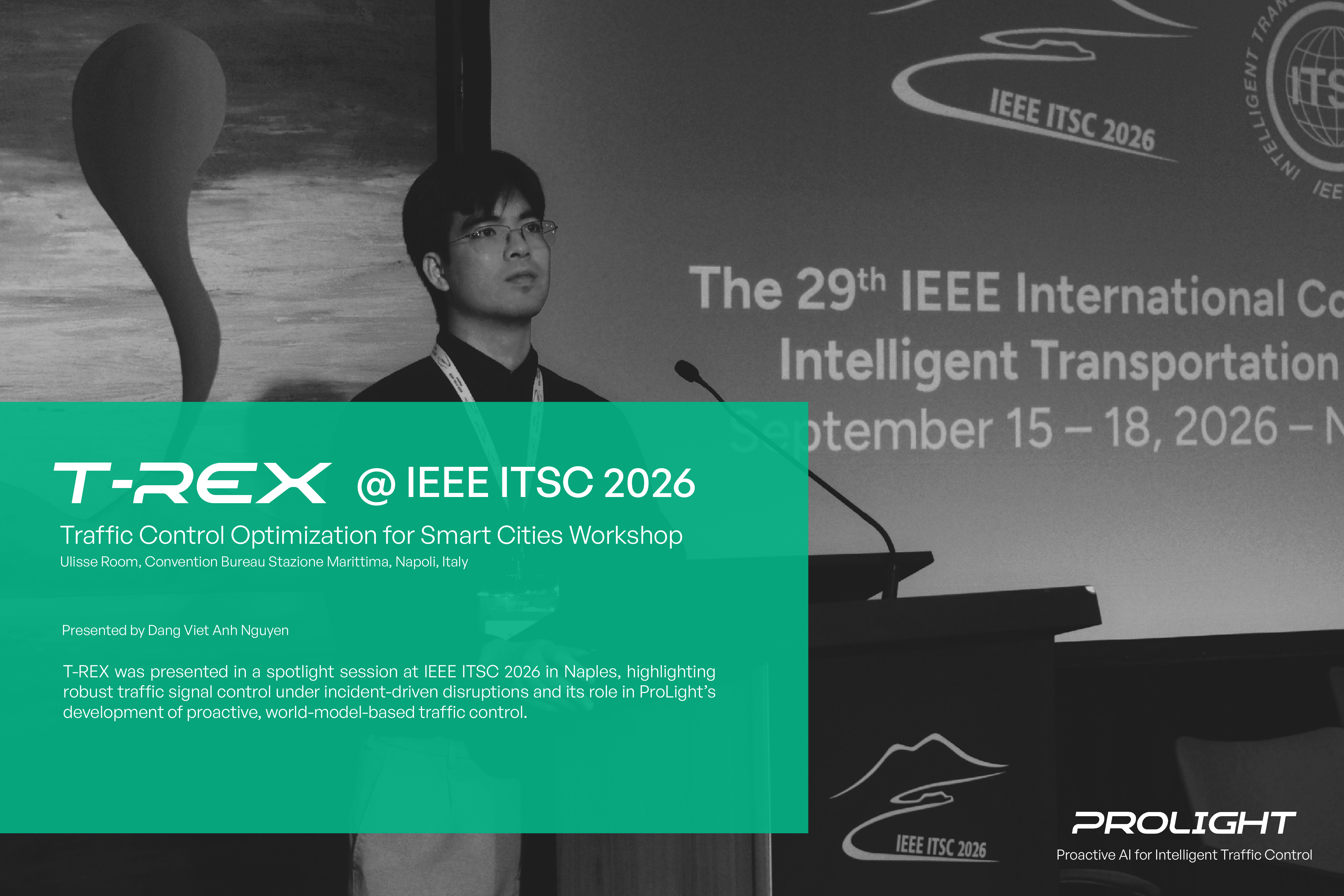
Spotlight at IEEE ITSC 2026
The spotlight presentation introduced the motivation behind T-REX, the incident modeling framework, and the robustness-oriented evaluation methodology developed for reinforcement learning-based traffic signal control. The discussion emphasized that traffic incidents create a fundamentally different control problem from recurrent congestion because they can trigger rapid and spatially propagating changes across the network.
Presenting the work at ITSC created an opportunity to discuss robustness-aware traffic control with researchers working across intelligent transportation systems, control, reinforcement learning, and smart-city mobility.
What is T-REX?
T-REX is an open-source, SUMO-based simulation framework for training and evaluating traffic signal control methods under disruptive traffic incidents. Instead of representing an incident only as a reduction in road capacity, T-REX also models how drivers react to disruptions and how those reactions propagate through the traffic network.
The framework supports lane blockages, probabilistic rerouting, speed adaptation, contextual lane changing, and network-level congestion propagation. These features make it possible to study not only traffic efficiency, but also the robustness, transferability, and adaptation behavior of learning-based traffic signal control methods under changing conditions.
Key message
The study shows that strong nominal performance does not necessarily imply robustness. Different reinforcement learning architectures can exhibit markedly different failure, generalization, and adaptation patterns when exposed to incident-induced distribution shifts.
This motivates a shift from evaluating traffic signal control only under stable traffic demand toward benchmarking methods under realistic disruptions and measuring how reliably they recover, transfer, and adapt.
Towards proactive traffic signal control
T-REX also provides an experimental foundation for the next stage of ProLight: developing proactive AI-based traffic control methods that can anticipate network evolution rather than react only to the current traffic state.
In particular, the framework supports ongoing work on GNN-MPC, which combines graph neural networks, model predictive control, and learned world models to predict future traffic conditions and select signal-control actions before congestion propagates through the network.
Paper and open-source resources
The work is now published open access in European Transport Research Review under the title “A framework for benchmarking traffic signal control robustness under incidents: comparative study of reinforcement learning-based methods.”
Published paper:
https://link.springer.com/article/10.1186/s12544-026-00841-1
T-REX tutorial and getting-started guide:
https://ai-prolight.eu/news/trex/
Learn more about ProLight:
https://ai-prolight.eu/